
Close
CART (0)
Insight · Outerwear
A barn coat is a hip-length work coat with a square, roomy cut, big outside pockets and a collar that turns up against the wind. It was made for morning chores on the farm and ranch, so it fits over a flannel, covers your belt and takes dirt and weather.
The material decides how warm it is. Shearling is the warmest and the most expensive. Leather blocks wind and dresses up. Wool is warm, easy to live with and costs the least.

I started Buffalo Jackson in Colorado in 2009, and the barn coat has always been one of the coats I measure the rest against. It is not a fashion piece that borrowed a ranch name. It is a coat built for a job: feeding stock before sunrise, splitting wood, standing in a cold field watching the dogs work. When we design one, the question I ask is simple. Would I wear it to do the chores and then straight to dinner in town? Here is what makes a barn coat a barn coat, how it differs from the coats it gets confused with, and how shearling, leather and wool compare.
Five details carry the style. A coat does not need every one, but the more it has, the more it reads as a barn coat.
A barn coat covers the belt and the top of the seat, so your lower back stays warm when you bend over a fence post or a feed bucket. It stops short enough that you can still climb into a truck or onto a tractor without it bunching.
It is cut straight through the body with room to move your arms. That room is the point: the coat goes over a flannel or a sweater without pulling.
Two large pockets at the waist, often with flaps, hold gloves, fencing staples, a phone and a pocketknife. Many barn coats add a chest pocket or hand-warmer pockets.
The classic barn coat collar is corduroy. On the warmer versions it is shearling or sherpa. Either way, it turns up against the wind and protects your neck.
Barn coats are cold-weather coats, so they are lined: blanket, quilting, sherpa or, on the best of them, the wool of the sheepskin itself.

These four get used almost interchangeably. They are related, but each one was built for a different day's work.
| Coat | Length | Lining | Signature detail | Built for |
|---|---|---|---|---|
| Barn coat | Hip, covers the belt | Warm: blanket, quilted, sherpa or shearling | Turn-up corduroy or shearling collar, big waist pockets | Cold-weather farm and ranch chores |
| Chore coat | Hip | Usually unlined | Three or four patch pockets, simple point collar | Three-season work, layering |
| Ranch coat | Hip to mid-thigh | Shearling or heavy pile | Often full sheepskin, western details | Hard winter on horseback and on the range |
| Field jacket | Hip to mid-thigh | Light, often removable | Four front pockets, often a hood or drawcord waist | Hunting and military field use |
The chore coat came out of French workwear in the late 1800s, the plain blue bleu de travail worn by laborers (Wikipedia: Chore jacket). The barn coat is the American farm version of the same idea, made longer and warmer for northern winters. A shearling barn coat like the Durango sits right where the barn coat and the ranch coat meet.
Most of the choice comes down to the material. Here is how the three compare, using our own coats as the examples.
| Shearling | Leather | Wool | |
|---|---|---|---|
| Warmth | Warmest. Built for days near and below freezing | Medium. Blocks wind; layer for real cold | Warm. A heavy wool blend with a sherpa or quilted lining |
| Weight | Heavy, but warm for its weight | Light to medium | Medium to heavy |
| Weather | Dry snow and drizzle; keep out of soaking rain | Sheds wind and light rain | Sheds light rain and snow, stays warm when damp |
| Break-in | Soft from day one; suede darkens with wear | Softens and takes on a patina over seasons | None needed |
| Care | Brush the suede, air dry, specialist cleaning | Wipe and condition once or twice a year | Brush, spot clean, store away from moths |
| Dresses up | Yes, especially in dark brown | Yes, easily | Yes, in solid colors and quiet plaids |
| Our coat | Durango, $1,195 | Sheridan, $479.95 | Wesley, $239.95; Ellis, $279.95 |
Prices as of October 2026. Each product page shows the current price and stock.
Shearling is sheepskin tanned with the wool left on. The suede side faces out and the wool faces in, in one piece, so nothing is glued, bonded or quilted in. It breathes, it holds heat without bulk, and it lasts for decades. The Durango uses Turkish merino shearling with a 12 to 14 mm pile, and I inspect the shearling myself before it goes into production. What I look for is thick, even wool and a supple skin, because that is what you feel on a cold morning.
Be careful with the word. A lot of coats sold as "shearling" are polyester sherpa bonded to faux suede. Our guide to shearling vs. sherpa shows how to tell them apart.


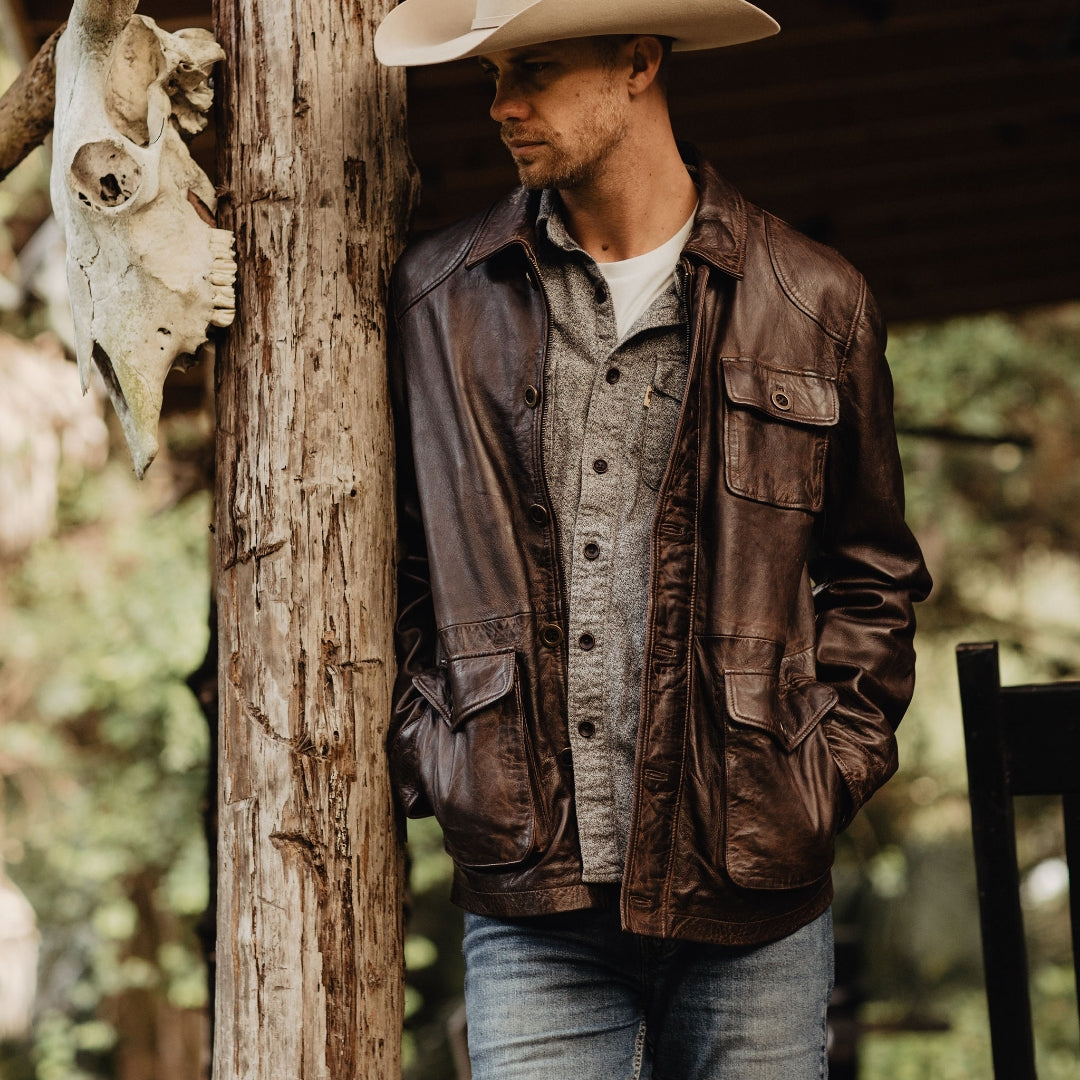
A leather barn coat blocks wind better than wool and gets better with every season you wear it. The Sheridan is full-grain lambskin, soft from the first day, with a full-length zipper hidden under antique brass buttons, so you can zip it, button it, or both when the wind picks up. It has two button-flap pockets at the waist, one at the chest, and zip and open pockets inside. It is the barn coat I would pick for a fall that runs from cool mornings to warm afternoons, and the easiest of the three to wear to dinner.
Wool is one of the oldest cold-weather fabrics there is (Britannica). The fiber takes up moisture vapor from the air and from your body without feeling wet, which is why a wool coat stays comfortable on a damp morning (The Woolmark Company). The Wesley Wool Barn Jacket is our wool barn coat: a heavyweight wool blend in herringbone or plaid, lined in sherpa, with horn buttons, big patch pockets and a longer hem that covers your belt in the saddle or the truck. The Ellis is its close cousin, a heavyweight brushed wool blend in a block plaid with a quilted lining, hand-warmer pockets at the chest, snap-flap patch pockets at the waist, and a sherpa or corduroy collar. For more on how wool compares with other insulation, see wool vs. down and wool vs. flannel vs. fleece.


A barn coat looks best when the rest of what you wear is plain and made for work.
In town, a dark shearling or a leather barn coat over a button-down looks as right at a restaurant as it does at a feed store.
Sizing differs by coat. On the Durango, Sheridan and Ellis, size up if you are between sizes. The Wesley has a boxier cut, so size down if you are between sizes. Every product page has a size chart, and our jacket fit guide covers measuring in detail.
We keep the barn coat line small: one shearling, one leather and two wool coats. You can see them all together in our men's barn coats collection.

Full sheepskin with Turkish merino wool inside, a shearling collar that turns up, five oversized horn buttons and two hand pockets. Our warmest coat. Saddle Tan in stock; Espresso Brown on pre-order.
$1,195 · Rated 4.8/5 by owners (6 reviews)
Shop Saddle Tan Shop Espresso Brown
Full-grain lambskin with a hidden full-length zipper under antique brass buttons, three outside pockets, two inside, and an easy-clean lining.
$479.95 · Rated 4.6/5 by owners (28 reviews)
Shop the Sheridan
Heavyweight wool blend lined in sherpa, with horn buttons, flannel-bound cuffs, a flap chest pocket, two patch pockets and a longer hem cut for riding. Four colors.
$239.95 · Rated 4.8/5 by owners (71 reviews)
Shop Brown Shop Gray Shop Brown Plaid Shop Sky Valley
Heavyweight brushed wool blend in a block plaid, quilted lining, hand-warmer chest pockets and snap-flap waist pockets. Sherpa collar on the Desert Valley, corduroy on the Navy.
$279.95 · Rated 4.7/5 by owners (28 reviews)
Shop Desert Valley Shop Navy PlaidOwner ratings on buffalojackson.com as of October 2026: the Wesley Wool Barn Jacket averages 4.8 out of 5 from 71 reviews, the Durango 4.8 from 6, the Ellis Wool Jacket 4.7 from 28, and the Sheridan Leather Barn Jacket 4.6 from 28.
"The coat itself is simply beautiful, quality stitching & construction, lambskin leather very soft and color is superb."
Teddy K., Sheridan Leather Barn Jacket"It fits perfect, is soft, warm and very comfortable. ... I'm 6 ft 2in, pretty fit, 235 lbs and the XXL fits great!"
Chris C., Sheridan Leather Barn Jacket"Great fit in the shoulders with tons of space for layers underneath. I can tell I can take this out on the coldest of nights and it'll hold up."
Tim F., Wesley Wool Barn Jacket"Beautiful / high quality jacket, it easily took the 43 degrees and it can go lower."
David S., Ellis Wool JacketA barn coat is a hip-length work coat with a square, roomy cut, big outside pockets and a collar you can turn up against the wind. It was built for farm and ranch chores, so it is made to be worn over a flannel or sweater and to take dirt, hay and weather.
A chore coat is a lighter, usually unlined work jacket with patch pockets, descended from French workwear. A barn coat is the cold-weather version: longer, warmer, lined, and usually finished with a corduroy or shearling collar.
A barn coat made from sheepskin tanned with the wool left on. The suede side is the outside and the wool is the lining, in one piece, so nothing is glued or quilted in. It is the warmest barn coat you can buy.
A lined leather barn coat blocks wind well and is warm enough for fall and early winter. In real cold, wear a sweater or vest under it, or choose shearling.
Shearling is warmer. A heavy wool coat with a sherpa or quilted lining is warm for most winter days and costs far less, but full sheepskin shearling holds more heat for its weight.
Leather and wool shed light rain and snow. Shearling handles dry snow and a drizzle but should be kept out of soaking rain. Let any of them dry at room temperature, never near a heater.
Roomy enough to button over a flannel or sweater, with the shoulder seam at your shoulder bone and the hem covering your belt. If you plan to layer heavily, size up on the Durango, Sheridan and Ellis. The Wesley is cut generously, so size down if you are between sizes.
Yes. Keep the rest plain: a flannel or button-down, dark jeans and boots. A leather or dark shearling barn coat dresses up easily, and a wool barn coat goes from the field to dinner without looking out of place.
Leather and shearling barn coats last decades with basic care: brush or condition them, hang them on a wide wooden hanger, and let them dry naturally. Wool lasts for years if you brush it and store it clean and away from moths.
For the coldest country, the Durango Shearling Barn Coat. For a tough coat that blocks wind and dresses up, the Sheridan Leather Barn Jacket. For a warm, lower-priced everyday coat, the Wesley Wool Barn Jacket or the Ellis Wool Jacket.
Further reading: the history of the chore jacket, sheepskin and shearling, Britannica on wool, and The Woolmark Company on how wool handles moisture.
Xan Hood founded Buffalo Jackson Trading Co. in 2009 and has spent the years since designing leather bags, jackets and the everyday gear a man carries, driven by a passion to see men come alive in the outdoors. He writes about the craft behind that gear and the wild places it's made for.