
Close
CART (0)
Insight · Leather Guide
There is no single best leather. Cowhide is the toughest and heaviest, and it takes the longest to break in. Goatskin is lighter and softer. Lambskin is the lightest and softest of the three, the easiest to wear every day, and the one that marks most easily.
Choose by how hard you will wear the jacket, how hot or cold it gets where you live, and how long you are willing to break it in. One caution up front: a moto-style jacket made for everyday wear is not riding gear. More on that below.

I started Buffalo Jackson in Colorado in 2009. We make moto-cut jackets in more than one hide, because the right hide depends on the man wearing it. I pick the hide for each jacket by the job the jacket has to do. Here is what separates cowhide, goatskin and lambskin, what each one is good for, and where a fashion jacket stops and real riding gear starts.
When people ask me about the Legacy, I tell them it is like Cone denim. You appreciate it when it is new, then you get to break it in and wear it into your own style. It is the thicker, heavier jacket. The Thompson is the other end of the line: soft and ready to go straight out of the box, and a little lighter in weight for everyday use.
Three questions settle most of it.
| Hide | Weight and feel | Break-in | How it ages | Best for | Our jacket |
|---|---|---|---|---|---|
| Cowhide | The heaviest. Firm and substantial | The longest. Stiff at first | Patina and color shift at the elbows and pressure points | Cool weather, hard daily wear, a jacket to keep for decades | Legacy |
| Goatskin | Lighter and softer than cowhide | Quick | Softens fast and takes on patina | Warm climates and everyday wear | Driggs in Brown (a trucker cut) |
| Lambskin | The lightest and softest. Thinner than cowhide | None needed. Feels worn in from day one | Deepens in patina over years, and marks more easily | Mild weather, easy daily wear | Thompson |
Our Thompson page puts the tradeoff plainly: lambskin is thinner and lighter-weight than cowhide, but it still does a good job of keeping out the cold. The Glenwood page adds that lambskin breaks in faster than cowhide and develops a deep patina over years of wear.
Cowhide is what most people picture when they think of a heavy leather jacket. The Legacy is full-grain cowhide, built with antique brass zippers, two zippered chest pockets and zippered sleeve cuffs. It is firm when you buy it, and it softens and darkens as you wear it. The Whiskey Brown develops a more visible patina than the Brown, which ages more quietly. If you want a jacket you will still be wearing in ten years, this is the hide.
Goatskin is lighter than cowhide and quick to break in. Our one goatskin jacket is the Driggs in Brown, a trucker cut rather than a moto. One owner in Texas wrote that goat leather simply made more sense there than cowhide: lighter, more comfortable in constant heat and more wearable day to day.
Lambskin is the softest and lightest hide, which is why the Thompson feels like a favorite jacket from the first day. It is thinner than cowhide, so it shows scuffs more readily and wants conditioning from the start. It is the right hide for mild weather and everyday wear.

This is the part most guides skip. Protective motorcycle leather is thicker, stronger and only moderately flexible, unlike fashion leather (Wikipedia: Motorcycle personal protective equipment). Riding jackets built for speed are also tested and rated. In Europe and the UK, motorcycle clothing is certified under EN 17092 in classes such as AAA, AA and A, and armor carries a CE mark.
The moto-style jackets we make are for everyday wear. They have no armor, and they are not rated or certified as riding gear. If you ride, wear a certified jacket with armor. If you want the cut and the character of a moto jacket for the street, the rest of this guide is for you.
The hide is half of it. The cut and the hardware are the rest.


Prices are as of November 2026. Each product page shows current price and stock. You can see the full leather motorcycle jackets collection too.
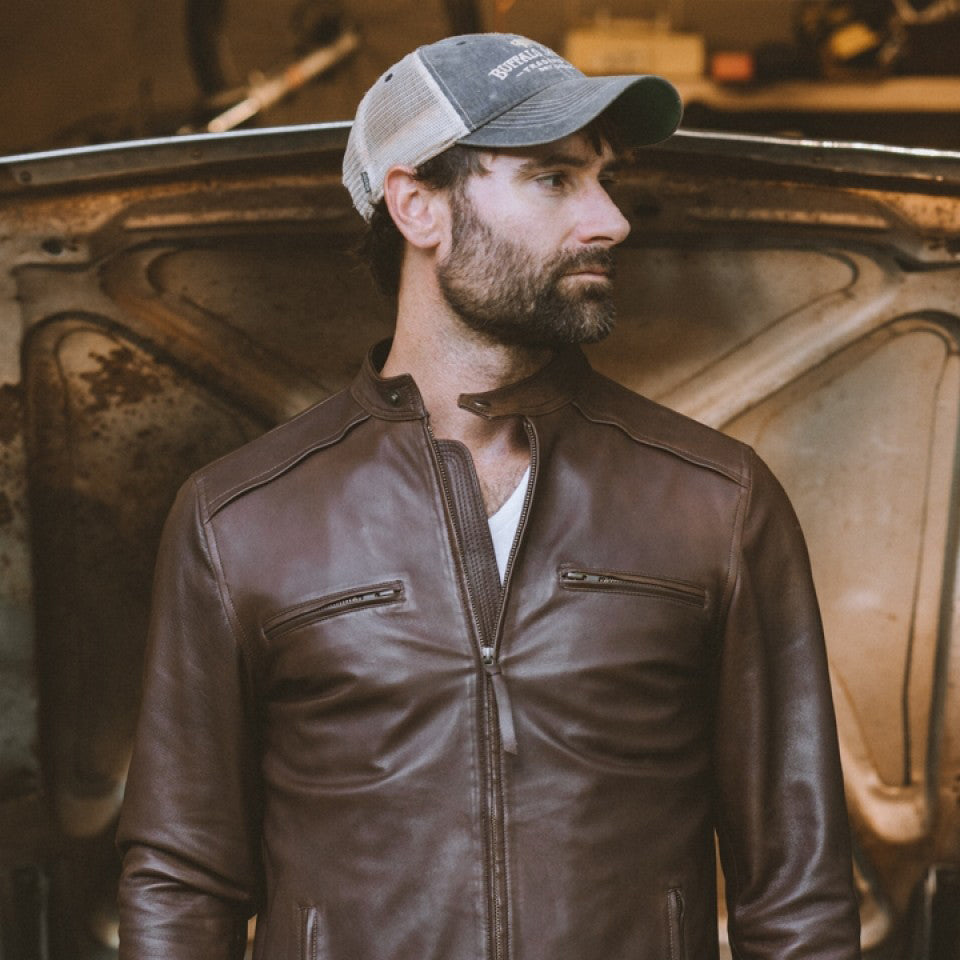
Full-grain lambskin with a snap collar, four exterior zippered pockets, an interior chest pocket, zippered cuffs, a quilted lining and antique brass finish zippers. Runs small, so size up.
$489.95 · Rated 4.7/5 by owners (69 reviews)
Shop Brown Shop Whiskey Brown Shop Black
Full-grain cowhide flight jacket with antique brass zippers, two zippered chest pockets, two welted front pockets and zippered sleeve cuffs. Fits trim, so size up.
$489.95 · Rated 4.8/5 by owners (179 reviews)
Shop Brown Shop Whiskey Brown
Our goatskin jacket, in a trucker cut with antique brass buttons, two chest flap pockets and two welted side pockets. Soft and quick to break in.
$459.95 · Rated 4.7/5 by owners (116 reviews)
Shop the Driggs


Owner ratings on buffalojackson.com as of October 26, 2026: the Legacy averages 4.8 out of 5 from 179 reviews, the Thompson 4.7 from 69 and the Driggs in Brown 4.7 from 116.
“Man, this is a great jacket. Real, heavy, thick, cowhide. Pull up effect is awesome!!”
Tim P., Legacy Leather Jacket“I have 5 other leather jackets and this one has quickly become my favorite. Rugged yet soft and pliable. Can’t wait for the patina to come in.”
Ryan C., Legacy Leather Jacket“Love the feel, the look, the color, and the smell, and feel this will last for a long time.”
Ryan U., Thompson Leather Moto Jacket“This was the first leather jacket I’ve ever purchased and it will probably be my last. The jacket is awesome, amazing quality and it fits perfectly.”
Eric F., Thompson Leather Moto Jacket | Black“I live in Texas and quickly realized that goat leather just makes more sense here than cowhide. I’m not working a ranch or riding a motorcycle, so goat leather is more than tough enough for my daily life.”
Bao H., Driggs Leather Jacket | BrownIt depends on use. For protective riding, jackets are made from thick, strong leather and are tested and rated. For an everyday moto-style jacket, cowhide is the toughest and longest lasting, goatskin is lighter and quick to break in, and lambskin is the softest and easiest to wear.
Cowhide is heavier, firmer and warmer, and it takes longer to break in. Lambskin is lighter, softer and ready to wear on day one, but it is thinner and marks more easily. Choose cowhide for cool weather and hard daily wear, and lambskin for mild weather and easy comfort.
Goatskin is lighter and softer than cowhide and quick to break in, which suits warm climates and everyday wear. Our only goatskin jacket is the Driggs in Brown, a trucker cut.
Protective riding leather is thicker, stronger and only moderately flexible, unlike fashion leather. Everyday jackets trade some of that thickness for comfort and a faster break-in. Lambskin is thinner and lighter than cowhide, and our jackets are made for everyday wear, not rated as riding gear.
Our moto-style jackets are everyday jackets. They have no armor and are not rated or certified as riding gear. If you ride, wear a certified jacket with armor.
Close through the shoulders, with sleeves that reach your wrist bone and do not ride up when you reach forward. The Thompson and the Legacy both run small, so size up and check the size chart.
Cowhide takes the longest, usually weeks of regular wear. Goatskin and lambskin are soft from the start and need much less. Wearing it is the best way to break it in. Do not use heat or water to speed it up.
No. Real leather is water-resistant, not waterproof. It handles rain and snow flurries, but in sustained rain it absorbs water. Wipe it dry with a clean cloth and let it air dry away from heat.
Condition the leather every three to six months, spot clean only, and store the jacket on a wide hanger. Start conditioning early on lambskin, which is thinner and shows scuffs more easily.
Further reading: Wikipedia on motorcycle protective equipment and its leather, armor and certification standards.
Xan Hood founded Buffalo Jackson Trading Co. in 2009 and has spent the years since designing leather bags, jackets and the everyday gear a man carries, driven by a passion to see men come alive in the outdoors. He writes about the craft behind that gear and the wild places it’s made for.