
Close
CART (0)

The Buffalo Jackson Journal · Story
There is a wildness written into the soul of a man. The question is whether he'll answer it.
Something is stirring again in America. You see it in the way a show about a Montana ranch family became the most-watched thing on television. You see it at rodeo grounds filling up with people who've never roped a steer. You see it in the way a man pulls on a worn canvas jacket in the morning and something in him — something he can't quite name — stands a little straighter.
Yellowstone didn't manufacture this. It just found a vein that was already running deep.
John Eldredge put words to it years ago that most men read and recognized like their own face in a mirror: "Deep in his heart, every man longs for a battle to fight, an adventure to live, and a beauty to rescue." He wasn't romanticizing. He was describing something structural — something built into a man at a level that no amount of comfort has ever been able to fully bury. The masculine heart needs, as Eldredge wrote, "a place where nothing is prefabricated, modular, nonfat, zip lock, franchised, online, microwavable. Where there are no deadlines, cellphones, or committee meetings. Where there is room for the soul."
The cowboy, whatever else he is, lives in that place.
People want to call the cowboy a myth. And sure — he's been romanticized, Hollywood-ized, draped in so much legend the seams show. But myths don't persist for a century and a half unless they're pointing at something real.
There's a reason the image keeps returning. The cowboy embodies a yearning most men know from the time they're boys — to go somewhere that requires something of them. To find a place where they can be all they suspect they were made to be.
"I went to the woods because I wished to live deliberately, to front only the essential facts of life, and see if I could not learn what it had to teach, and not, when I came to die, discover that I had not lived."
— Henry David Thoreau
Thoreau wasn't running from anything. He was running toward something. The frontier — geographic or otherwise — has always served that purpose. It strips away the scaffolding of ordinary life and shows a man who he actually is underneath.
Hemingway chased the same thing his whole life — the clean, hard truth of the bullfight, the trout stream, the African plains at first light. "The world breaks everyone," he wrote in A Farewell to Arms, "and afterward, many are strong at the broken places." The frontier doesn't promise you won't get broken. It promises that the breaking will mean something.
The hunger cycles back every generation because it's never been fully satisfied by the substitute. You can't get what the wilderness offers from a screen, a suburb, or a standing desk. Something in every man knows this — even the ones who've never been able to say it out loud.
No story makes this plainer than Theodore Roosevelt.

On the same night in February 1884, Roosevelt lost both his mother and his wife. He was twenty-five years old, a rising New York assemblyman, wealthy, educated, and completely undone. In his diary that night, he drew a large X and wrote beneath it: "The light has gone out of my life."
He went west.
He arrived in the Dakota Badlands as something of a spectacle. His neighbors chuckled at the "Bully!" and "Deeelighted!" that punctuated his speech. His thick eyeglasses earned him "Four-eyes," which alternated with "the Dude." He was a Harvard man in a land that had little use for Harvard. The ranch hands were politely skeptical and not entirely polite about it.
But Roosevelt had made a decision that separates a small number of men from the rest: he chose to become someone he was not yet, and he meant it.
He dressed for it first. He ordered the buckskin shirt, the moccasins, the silver spurs, the fringed everything. (Our Roosevelt Collection is named in his honor.) In a letter back East, he wrote to his sister: "I now look like a regular cowboy dandy, with all my equipments finished in the most expensive style." The men around him could see exactly what he was doing, and they weren't impressed.
But the clothes were a declaration, not a disguise. Every morning he buckled that gear on, he was making a choice about who he was becoming.
Then he went to work. He threw himself into Badlands life — stopping stampedes, riding through month-long roundups, arresting thieves, punching out a drunken gunslinger who'd pushed too far, organizing the region's first stockmen's association. He earned, slow and hard, what the clothes could only gesture at. The men who had laughed began to respect him. Then to trust him. Then to follow him.
"If I had not spent my time in North Dakota, I would never have become President of the United States."
— Theodore Roosevelt
He left New York as Theodore. He came back as Teddy. The Badlands didn't hand him a new identity. They stripped away everything false until the real one could breathe.
Watch a man when he gets dressed for something that matters.
Not a meeting. Not a commute. When he's heading somewhere that requires something — a long day of real work, a hunt, a stretch of river he's been thinking about for weeks. There's something in the way he moves. He's not performing. He's preparing.
The clothes are part of this. Not because they make the man — they don't, and every man who's ever bought a pile of gear he wasn't ready for knows this — but because they can call something out of him. They put his body in the posture of the man he intends to be. And that matters more than most people admit.
Roosevelt understood this instinctively. He didn't wait until he felt like a cowboy to dress like one. He dressed like one, went to work, got laughed at, kept working, got broken, kept going, and one day — not dramatically, but truly — he was one.
William James, who watched human nature as carefully as anyone in his century, said it plainly: "Act as if what you do makes a difference. It does."
Western clothing earned its form the hard way. Wide brims for sun and rain. Boots built for stirrups and long days standing. Denim that wouldn't quit. The function came before the form, and the form followed the life. To put these clothes on isn't nostalgia — it's, at its best, a man reaching for something harder and truer than the life he's been living.
"Clothes make the man. Naked people have little or no influence on society."
— Mark Twain
He said it with a grin. But there's more in it than the joke. The way a man dresses is a declaration about who he believes himself to be. And declarations, made consistently and backed by action, have a way of becoming real.

Buffalo Jackson Trading Co.
Full-grain leather. Built for the long haul. The kind of jacket that gets better the harder you live in it — and tells the story of where you've been.
Shop Leather JacketsThe Yellowstone effect is real and it's significant. Rodeos that were half-empty are full again. Boot makers can't keep up. An entire generation that grew up scrolling through everything is reaching for something with texture and weight.
It would be easy to write this off — a cultural moment, a fashion cycle, nostalgia for a West most of these people have never seen.
But that reading is too cheap. Most people aren't fools. They know the difference between a show and a life. What they're reaching for — through the worn denim and the long evenings watching the Duttons hold their ground against everything modernity throws at them — is something real. They're reaching for a story worth being part of. A life that asks something of them. A version of themselves they respect.
The Western genre has always been less about the West and more about the question underneath it: Who are you when everything's stripped away?
"The mountains are calling and I must go."
— John Muir
Every man who reads that sentence feels the pull — not necessarily to mountains, but to something. Something out past the edge of the comfortable and the managed.
The question is never whether the call is real. The question is whether you'll answer it.
Not by watching another season from the couch. But by doing what Roosevelt did in 1884, what Thoreau did in 1845, what every man who has ever earned his place has done before you: you go. You show up. You do the hard thing. You let it break you where you needed breaking all along.
Sometimes the reaching starts somewhere smaller. Sometimes a man laces up a pair of boots that mean real work, or pulls on a jacket worn enough to carry a little story, and something in him straightens. Not because the clothes made him something he wasn't — but because they reminded him of something he forgot he was.
The West has always been less about a place than a posture. A willingness to trade comfort for truth. Safety for story. The managed life for the one that actually demands something of you.
It's still out there. The only question is whether you're dressed for where you're actually going.
Buffalo Jackson Trading Co. Durango Shearling Jacket

 shearling lining. The kind of warmth that comes from something built to last a lifetime, not a season.
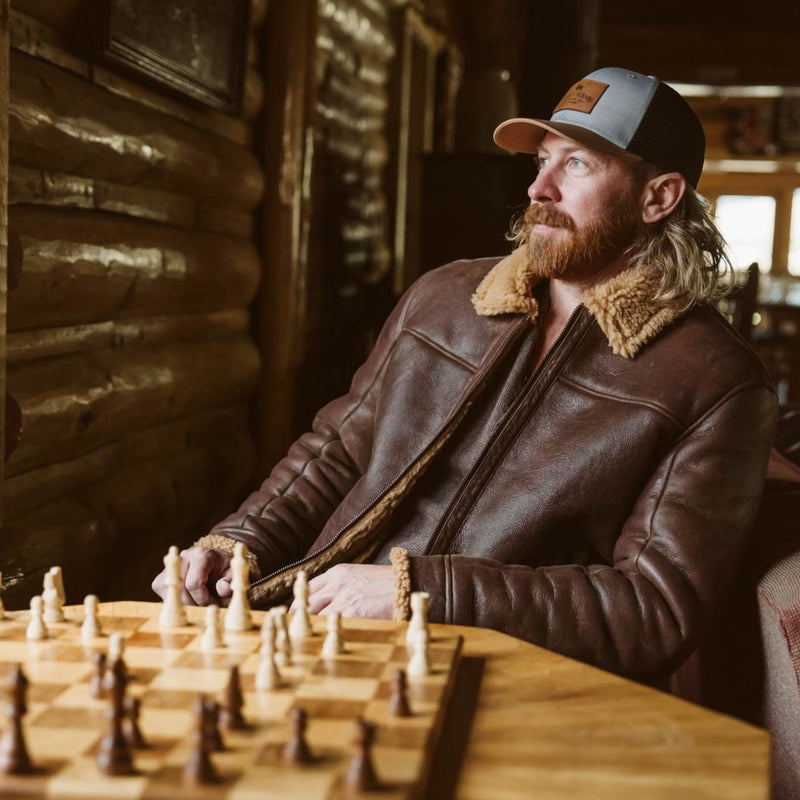

Written by
Xan Hood
Founder and CEO of Buffalo Jackson, a heritage leather goods and outerwear brand started in 2009. Xan leads product development personally and writes about full-grain leather, craftsmanship, and heritage apparel from 17 years of firsthand experience.
More about Xan →