
Close
CART (0)

Insight · Fit Guide
A leather jacket fits differently than every other coat in your closet. The size chart is a starting point — not an answer. This is the long version of what we tell every customer who calls.
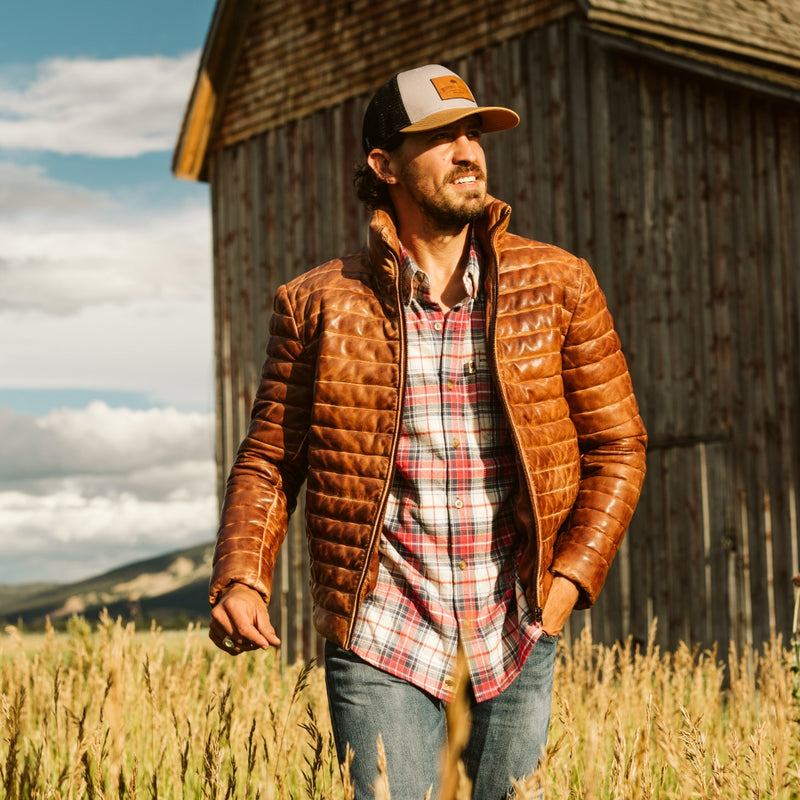
Of all the questions our customer service team gets, the one that comes up most often is some version of what size should I order? It does not matter how detailed the size charts are, how many measurements we list, or how clearly we say "this style runs slim." Leather jackets are one of the few garments where a man who has worn a size large his whole life can put on a size large and have it not fit at all.
That is not a defect. That is leather doing what leather does. A wool topcoat, a flannel shirt, a hoodie — these all give. They drape, they stretch, they forgive. Leather does almost none of that, especially in the places that matter most. Which means the rules for sizing a leather jacket are different from the rules for sizing anything else.
This guide is the long version of the answer we give every day on the phone. If you read all of it, you will know more about leather jacket sizing than ninety percent of the people selling them.
Three things are happening at once when you put on a leather jacket, and all of them work against the size you usually wear.
The leather itself is rigid. A quality full grain hide is between 0.7mm and 1.2mm thick — roughly the thickness of a credit card, wrapped around your torso, sewn shut. It does not stretch when you reach forward, it does not compress when you sit down, and it will not forgive a chest measurement that is half an inch too tight. A cotton shirt at the same chest measurement will feel fine. A leather jacket at the same chest measurement will feel like a corset.
The pattern is cut closer to the body. Leather jackets are designed to look sharp, and the silhouette is part of the appeal. Designers cut them with less ease — meaning less extra fabric between the garment and your body — than a sweatshirt or a barn coat. A medium leather jacket and a medium hoodie are not built around the same numbers. The hoodie is built around your chest plus four to six inches of breathing room. A leather jacket is often built around your chest plus two or three.
You are probably going to wear something under it. Almost no one wears a leather jacket directly against bare skin. There is a tee, a henley, a button-down, sometimes a flannel. Each of those layers takes up space the jacket has to accommodate. The size chart does not know what you are planning to wear underneath. You do.
Add those three factors together and the math gets clear: a leather jacket in the size you usually wear is probably going to fit you tighter than you want.
Forget the chart for a second. Ask yourself this: what is the heaviest layer I am realistically going to wear under this jacket?
If the answer is a thin tee — a clean racer-style jacket on warmer evenings, paired with a single light layer — order your normal size. You will get the close, sharp silhouette the jacket was designed to show off.
If the answer is a flannel or a button-down — the most common case for our customers — strongly consider sizing up. A flannel takes up real space inside a jacket, and the difference between a medium and a large is often the difference between a jacket that lets you button the flannel underneath and one that doesn't.
If the answer is a sweater or a hoodie — you are using the jacket as a true outerwear shell — size up without thinking twice. There is no version of this where your normal size is the right call.
This single question solves more sizing decisions than any tape measure will.
If you are going to use a tape measure — and you should, at least once — these are the five numbers that determine whether a leather jacket fits. Take them while wearing the layer you plan to wear under the jacket.
A clean illustration showing where to measure: shoulder-to-shoulder, chest circumference, sleeve length, jacket length, bicep. The same diagram you use on product pages would work — pull from /cdn/shop/files/BuffaloJackson_LeatherJacketFitAdvice_BridgerLeatherDownJacket image.
This is the most important measurement on the list, and the one most men skip. Have someone measure across your back, from the bony point of one shoulder to the bony point of the other, in a straight line. The shoulder seam of the jacket should land directly on that point — not out on your upper arm, not pulled toward your neck.
Shoulder fit cannot be tailored after the fact. Chest can be taken in. Sleeves can sometimes be shortened. Length can be hemmed. Shoulders are built into the pattern. If the shoulder seam is in the wrong place when you try the jacket on, it will be in the wrong place forever. For more on the basics of how a leather jacket should fit, our shorter overview covers the same ground from a different angle.
Wrap the tape measure around the fullest part of your chest, under the armpits, with the layer you plan to wear underneath. Keep the tape level — do not let it ride up in the back. Compare against the chest measurement on the size chart, not your t-shirt size.
One thing most charts don't tell you: the listed chest measurement is the garment measurement, not the body measurement. A medium with a 42" chest means the jacket itself measures 42" around. If your body is 42", the jacket will fit you skin-tight. You want at least 2" of difference between your chest and the garment chest, more if you plan to layer.
Measure from the center of the back of your neck, across your shoulder, down the outside of your arm, to the bone on the back of your wrist. Keep your arm slightly bent — straight-arm measurements run short. The sleeve should end right at that wrist bone. A little shorter is fine. Riding up the forearm is not.
One small note on leather specifically: sleeves on a new jacket can feel slightly stiff, and the cuff can sit a half inch higher than it will after a few weeks of wear. The leather softens, the elbow breaks in, and the sleeve settles into its real length. Don't panic about a quarter inch.
Measure from the base of your neck, down your back, to where you want the jacket to end. For most leather jackets — bombers, truckers, racers — that point is somewhere between the top of your belt and the bottom of your hip pockets. Too short and the jacket looks cropped. Too long and it starts to look like a coat instead of a jacket.
If you are tall, this is the measurement to watch most carefully. Many leather jackets are cut for an average male torso, and a six-foot-three man in his standard size will sometimes find the jacket length is fine but the proportions look short.
This one matters more than you think, and most charts don't list it. Wrap the tape around the largest part of your upper arm while it's flexed slightly. Leather has almost no give through the upper sleeve, and a jacket that is tight in the bicep will feel tight every time you bend your elbow — which is constantly.
If you lift weights, do physical work, or just have larger arms, this is the measurement that often forces a size up even when chest and shoulders fit.
Not all leathers behave the same way once you start wearing them. This affects sizing in real ways.
Full grain cowhide is the heaviest, most durable, and least forgiving leather we use. Our Bridger and Legacy jackets are built with this hide. Cowhide softens noticeably over the first month — it stops feeling like armor and starts feeling like a jacket — and the shoulders, elbows, and back will mold to your body. What it won't do is grow into a fundamentally larger size. A cowhide jacket that feels snug at the chest will give a small amount and become comfortable. A cowhide jacket that feels restricting will stay restricting. (For more on how leather grades behave differently, our leather jacket buying guide walks through full grain, top grain, and corrected grain in detail.)
Goatskin is softer than cowhide and has more natural stretch, especially across the back and through the elbows. Our Driggs leather trucker is built from full grain goat. Goatskin has a slightly more forgiving fit than cowhide at the same listed measurements, but the rules don't change — size for the layer you plan to wear, not for the leather to stretch into.
Lambskin is the softest of the three, with the most give. It feels broken in from the first wear and will mold to your body over a few weeks. Our Thompson moto is lambskin. This is the only leather where you can reasonably expect a small amount of growth in the chest and shoulders — but small means small. A jacket that is significantly tight in lambskin will still be tight after six months, just slightly less so.
Sheep leather sits between lambskin and goatskin in feel. The Glenwood, our driving jacket, is full grain sheep. It is supple from the first wear, drapes beautifully, but should still be sized for the layer you intend to wear underneath rather than for stretch.
Here is the part most sizing guides miss, and it is the part that changes how you should feel about the jacket the day it arrives.
Leather is not cotton. It is not wool. It is not a synthetic blend. Leather is animal hide, and it behaves the way a good pair of boots or leather work gloves behave — it forms to the body of the person wearing it. A new pair of quality boots feels stiff. The leather is unyielding across the top of your foot. The heel rubs in places it won't rub a month from now. A week in, the boot has started to remember the shape of your foot. A month in, it is the most comfortable pair of shoes you own. Two years in, it fits no one else.
A leather jacket does the same thing. The hide softens with body heat. The shoulders learn the slope of your shoulders. The elbows learn how you bend your arms. The chest gives a small, gradual amount where it needs to. The jacket does not stretch into a different size — but it does mold into your shape inside its size.
A close-up shot showing the difference between a new leather jacket and a well-broken-in one — elbow creases, shoulder roll, softened collar. Could be a side-by-side or a single hero shot of a Legacy or Bridger that's been worn for a year. This is the emotional center of the article and deserves a strong visual.
This matters for how you should evaluate the fit on day one. A new leather jacket should feel snug, not restricting. There is a meaningful difference between those two words.
Snug is what a new boot feels like — close to the body, a little firm across the chest, slightly stiff in the shoulders. You can move. You can breathe. You can reach for the steering wheel without the jacket pulling at the seams. Snug breaks in. Snug becomes the perfect fit four weeks from now.
Restricting is different. The chest pulls so hard that the buttons or zipper visibly strain. The shoulder seams sit out on your upper arm and pull when you reach forward. The bicep cuts off circulation when you bend your elbow. Restricting does not break in. Restricting means the jacket is the wrong size, and no amount of wearing will fix it.
The line between the two is mostly about movement. If the jacket is tight standing still but you can move freely, that is snug — and it will give. If the jacket forces you to change how you move, that is restricting — and it won't.
So when your jacket arrives and your first reaction is "this feels a little tight in the chest," do not immediately send it back. Put a tee on, put the jacket on, button or zip it, and try the test below. If the jacket holds its shape but you can move, that is exactly what a new leather jacket is supposed to feel like. Wear it for two weeks. The chest will give. The shoulders will round. By the end of the first month, you will have a jacket that fits you better than any garment you own — because it now fits no one else.
This is also the reason cheap leather jackets do not get better with age. Bonded leather, corrected grain, and synthetic-coated hides do not have the natural fiber structure to mold to a body. They wear out instead of breaking in. Full grain leather is the only material in your closet that has this particular trick, and it is one of the main reasons a quality leather jacket is worth the investment. (Once you've found the right one, conditioning it properly is what carries it through the next twenty years.)
Size Up If
Stay True If
Size Down Only If
For most men, "size up" wins more often than the other two combined. If you are reading this guide because you can't decide, that is your answer.
This is the section most other guides cannot write, because they do not know the jackets the way we do. Here is honest, style-by-style fit guidance from people who measure these jackets every week.
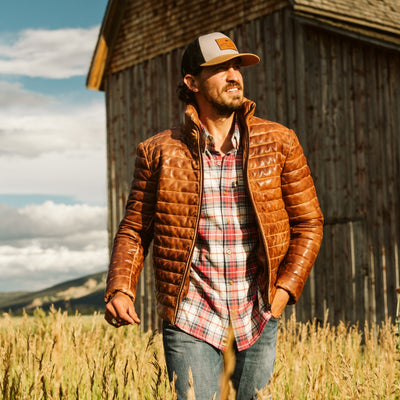
Fits a little trim through the chest. If you are between sizes or plan to wear a flannel underneath, size up. Shop the Bridger →
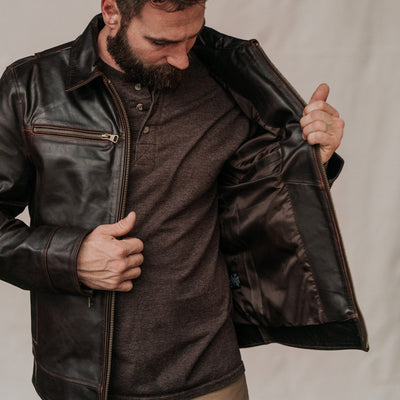
Cut on the slim side, designed to capture the vintage flight jacket silhouette. If you are between sizes, size up. Shop the Legacy →

Built in full grain goat with a clean trucker silhouette. Trucker jackets are traditionally cropped and slim through the body. If you are tall, check the length carefully. If you have a broader chest, size up. Shop the Driggs →

Lambskin, slim cut, designed to look sharp. True to size for most men wearing a tee underneath. Size up if you plan to layer. Shop the Thompson →

Inspired by the driving jackets of the 1950s and 60s, with a toggle waistband for adjustment. Runs a little large in sizes Small through Large — most customers in those sizes will want to order their normal size, not size up. If you are between sizes, stay true. Shop the Glenwood →

A more relaxed fit than the Legacy. True to size for most men. Shop the Maverick →
Once your jacket arrives, before you cut the tags, run through this checklist with the layer you plan to wear underneath already on.
Either a four-panel grid (shoulder seam check, arms-forward reach, elbow bend, side profile for length) or a single clean fit-check photo. Could repurpose a video frame from your existing product video shoots.
If anything fails the test, the jacket is the wrong size. Send it back and order the next size up. We provide prepaid return shipping labels on every domestic exchange — there is no penalty for getting it right.
Skip the Tape Measure
If you would rather not measure yourself, our fit app asks a few questions about your build and recommends a size in seconds. Built specifically for our jackets, with our patterns. The whole thing takes under a minute.
Buying a leather jacket online without trying it on first is one of the higher-stakes purchases in a man's wardrobe. The investment is real, the fit is unforgiving, and a jacket that does not fit ends up unworn in a closet — which is the worst outcome for everyone, you included.
The good news is that a leather jacket is also one of the few garments where, when you do get the size right, you have made a purchase that will last twenty years. Maybe more. Our customers regularly write in about jackets they have had for a decade that they have just now started to consider passing down to their sons.
Spend ten minutes with a tape measure. Be honest about the layer you actually plan to wear underneath. When in doubt, size up. And if the first one is wrong, send it back and try the next size — we built our exchange policy around exactly this scenario, because we would rather you have the right jacket than the first one.
The right leather jacket is worth the small effort it takes to find your size. Take the time.
Built to Roam™
Full grain leather, built to last. Sized to fit.
Shop Leather JacketsDo leather jackets run small?
Most leather jackets do run smaller than the equivalent size in a sweatshirt or wool coat. Leather is cut close to the body to look sharp, and unlike a hoodie, it has very little give in the chest and shoulders. This is why a man who wears a medium tee will often need a large in a leather jacket — especially if he plans to layer underneath.
Should I size up in a leather jacket?
If you fall between sizes, almost always size up. Leather will mold to your body the more you wear it — softening in the chest, rounding in the shoulders, breaking in at the elbows — but it will not grow into a fundamentally different size. A jacket that is genuinely restricting in the shoulders on day one will still be restricting six months in. A jacket that is snug but lets you move will become the best-fitting jacket you own.
How should a leather jacket fit?
A well-fitting leather jacket sits flush across the shoulders without pulling, closes comfortably across the chest with one mid-weight layer underneath, ends at the wrist (not the knuckles), and falls between the belt and the bottom of the hip pockets in length. You should be able to reach forward without the back of the jacket pulling at the seams.
Will a leather jacket stretch out over time?
Lambskin and goatskin will soften and give a small amount, mostly in the elbows and across the back. Full grain cowhide barely moves. Do not buy a leather jacket assuming it will stretch into the right size — buy the size that fits you on day one, with the layer you actually plan to wear under it.
What is the most important measurement for a leather jacket?
Shoulder width. Chest can be adjusted by a tailor, sleeve length can sometimes be shortened, and length is usually a non-issue for a quality jacket. Shoulder seams that sit in the wrong place — either out on the upper arm or pulling toward the neck — cannot be fixed. Measure shoulder-to-shoulder across your back and trust that number above any other.

Written by
Xan Hood
Founder and CEO of Buffalo Jackson, a heritage leather goods and outerwear brand started in 2009. Xan leads product development personally and writes about full-grain leather, craftsmanship, and heritage apparel from 17 years of firsthand experience.
More about Xan →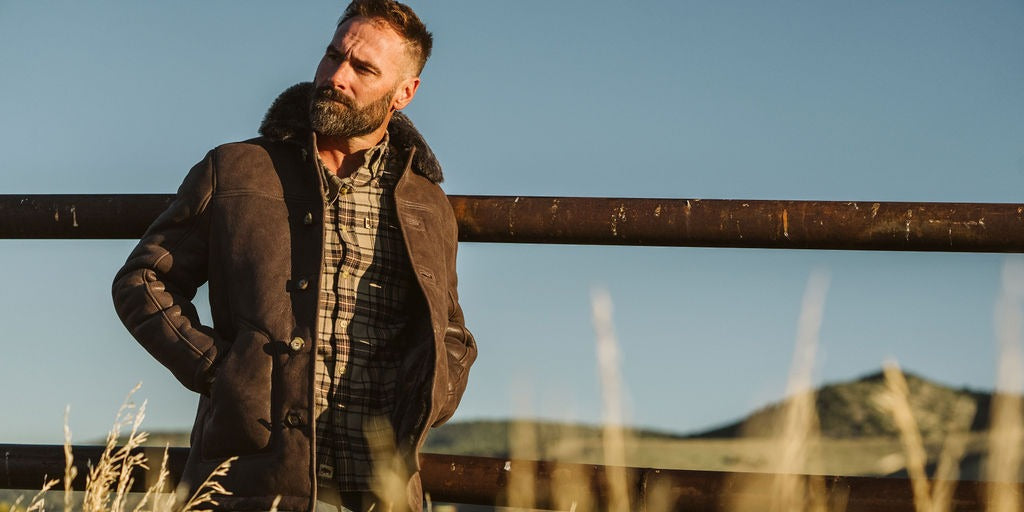
What makes a coat a barn coat, how it differs from chore coats, ranch coats and field jackets, and how shearling, leather and wool barn coats compare for warmth, weather and fit.
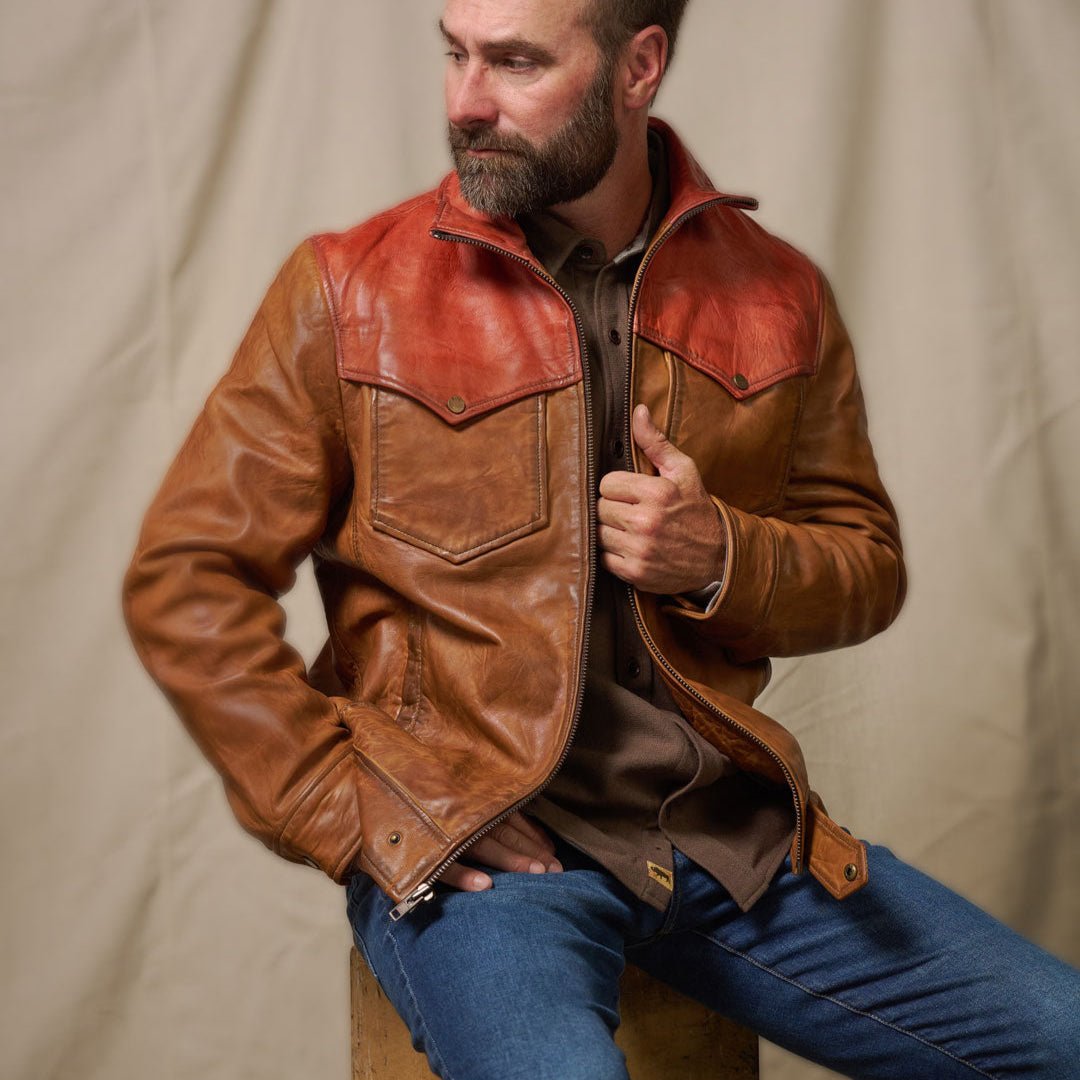
What makes a leather jacket or vest western, how western differs from trucker, moto and bomber cuts, which leather to choose, and how to wear it without looking like a costume.
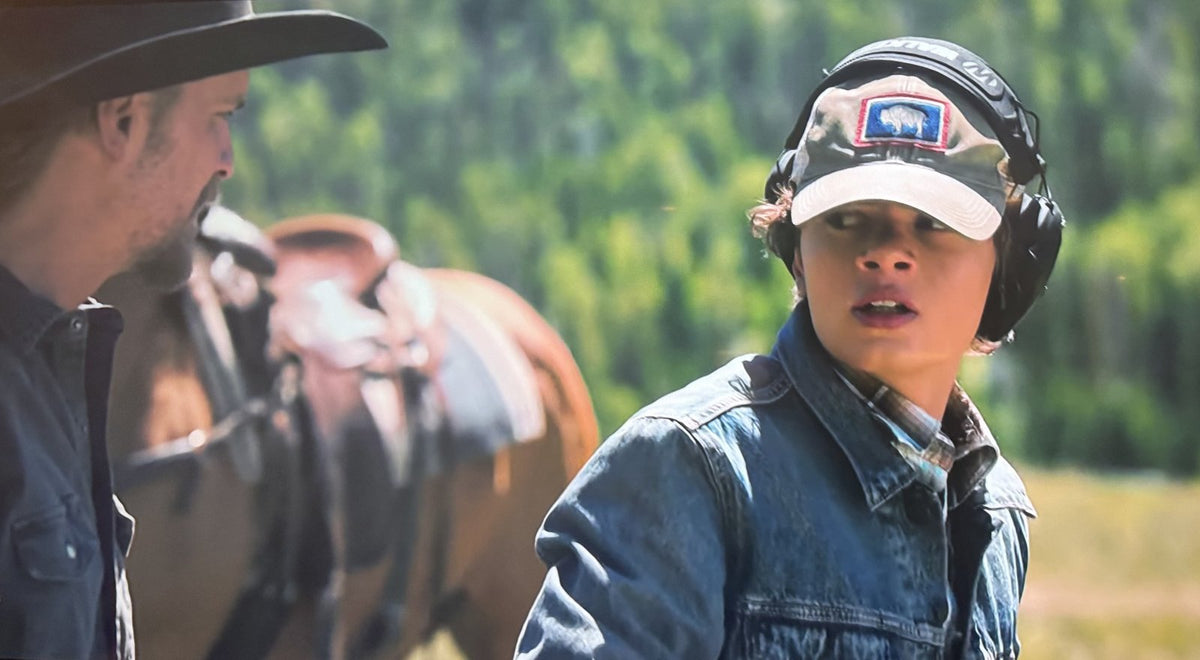
The buffalo flag cap Tate Dutton wears on Yellowstone and Marshals is the Buffalo Jackson Vintage Wyoming State Flag Hat in Green/Grey. The show's team asked us for it after Yellowstone's second season. Here is how to spot the real one.